
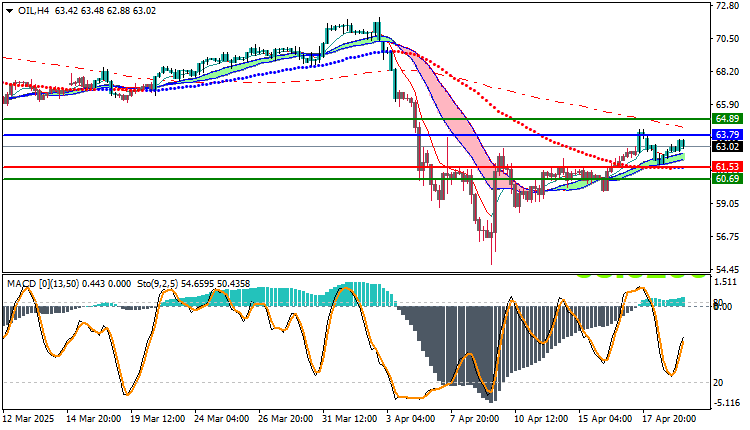
After a sharp collapse in early April that pushed oil prices below $60, the price has begun to consolidate and gradually return to its upward trend. We now observe technical stability above the 63.00 area, with a clear test of key resistance levels. Are we witnessing a gradual return to the upside, or is this rebound merely a temporary correction before the decline resumes?
A Quick Look at the Current Situation
- Current Price: 63.02
- Short-Term Trend: Gradually Up
- Medium-Term Trend: Still Down
- Nearest High Resistance: 64.89
- Current Key Support: 61.53
The price has experienced a strong rebound from the 60.69 area to the 63.79 barrier, but it now faces strong resistance around 64.00, which requires a strong breakout to confirm the return of the upward trend.
Detailed Technical Analysis
Technical Indicators:
- MACD: Bullish after a positive crossover, with movement above zero.
- Stochastic: In a neutral, bullish zone, suggesting a continuation of the current momentum if it exceeds the 65 level.
Today’s Trading Forecasts and Scenarios
Bullish Scenario (Probably):
- If it holds above 63.00 and the current momentum continues, oil may succeed in surpassing 63.79 and then target 64.89 and possibly 66.00.
Bearish Scenario (Corrective):
- If selling pressure emerges and the price returns below 61.53, prices may decline towards 60.69 and then 59.50.
Trading strategies based on Buy/Sell level
| USOIL | In case of buying | in case of selling |
| Entry point | 63.79 | 61.53 |
| Target Point 1 (TP1) | First resistance: 64.89 | First support: 60.69 |
| Target Point 2 (TP2) | Second resistance: 65.90 | Second support: 59.10 |
| Stop Loss (SL) | 61.53 | 63.79 |
West Texas Intermediate (WTI) crude oil is showing positive technical signals after a period of selling pressure, supported by a MACD crossover and a bullish trend in the moving averages. However, with strong resistance at 64.89, the price needs an economic catalyst or positive inventory data to confirm a move forward. Until then, caution is advised, especially as volatility persists.


