
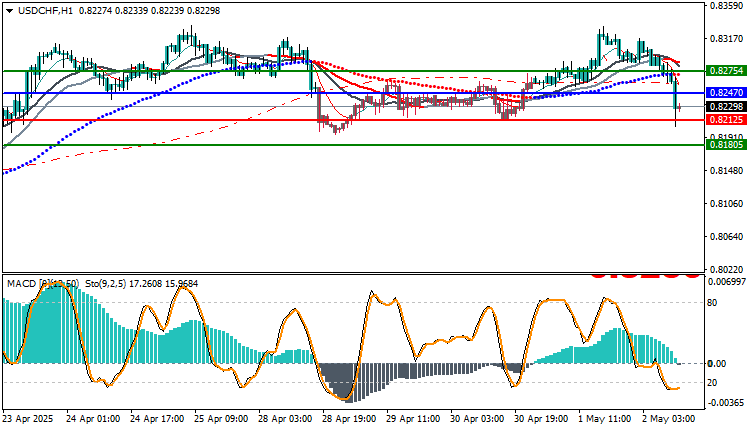
USDCHF Technical analysis Today: The USDCHF pair suffered a sharp decline during this morning’s trading after failing to maintain trading above 0.8275, breaking key support levels due to profit-taking ahead of Friday’s US employment data.
The market is in a state of anticipation, and current movements reflect a short-term corrective bias.
USDCHF Technical analysis Today: Technical Overview
- General trend: Short-term bearish
- The price has broken the support levels of 0.8240 and 0.8225
- Currently trading near the support level of 0.8210, with a potential for a temporary rebound
Technical Indicators Analysis:
- Moving Averages (EMA):
- The price is below the 50, 100, and 200-day moving averages
- A clear negative crossover supports a continued decline
- MACD:
- In the negative zone with strong selling momentum
- No reversal signals yet
- Stochastic:
- In the oversold zone (<20)
- A temporary technical rebound may occur provided it holds above 0.8210
Expected Technical Scenarios:
Bearish Scenario (likely):
- Continued trading below 0.8225 could push the pair towards:
- 0.8205
- 0.8185
Bullish Scenario (likely corrective):
- A rebound from 0.8210 Retests:
- 0.8235
- 0.8247
Trading strategies based on Buy/Sell levels
| In case of buying | in case of selling | USDCHF |
| 0.82470 | 0.82125 | Entry point |
| First resistance: 0.82754 | First support: 0.81805 | Target Point 1 (TP1) |
| Second resistance 0.83054 | Second support 0.81505 | Target Point 2 (TP2) |
| 0.82125 | 0.82470 | Stop Loss (SL) |
USD/CHF has been moving in a downward trend since the beginning of the week, with critical technical supports broken and a clear decline in upward momentum.
Tomorrow’s jobs data will be the deciding factor in confirming the decline or setting the stage for a stronger rebound.
Expected Economic Data:
- Friday, May 3, 2025:
- US Nonfarm Payrolls (NFP) Report
- US Unemployment Rate
Any surprise in these figures could directly impact the strength of the dollar, and thus the performance of the USD/CHF, especially since the pair is highly sensitive to US monetary policy.


